- Digital depression therapy
- Free on prescription
- Immediate access, no waiting time
- CE-marked medical device
deprexis: trusted worldwide.
deprexis is for you, if…

... you often feel empty inside and struggle to find joy.

… you feel exhausted and drained, and even small tasks take a lot of energy.

... you want to regain routine and structure in your daily life.

… you are experiencing depression and want to start therapy quickly.

… you want to make good use of waiting times for a therapy spot.

… you want an extra layer of support alongside your current therapy.
Facing depression? deprexis.
deprexis is a globally utilized, scientifically proven digital therapy for adults with depression. Effective for mild, moderate, and severe symptoms.
deprexis supports you in managing depressive symptoms and can help create lasting improvements in your daily activity and well-being – whether used on its own, alongside therapy, or while waiting for a treatment spot.
All from the comfort of home – with zero waiting times and immediate access.
deprexis is a CE-marked medical device.


275,000+
patients

83% recommendation rate

15+ years
of experience

16 clinical
trials
Because your mental health comes first – deprexis is fully covered by public health insurance.






What sets deprexis apart from standard health apps?
Discover deprexis –
empathetic, personal, and built for everyday life.
deprexis supports you with empathetic, virtual conversations designed to work just like psychotherapy. You will receive psychological insights and exercises that offer support right where you need it most.
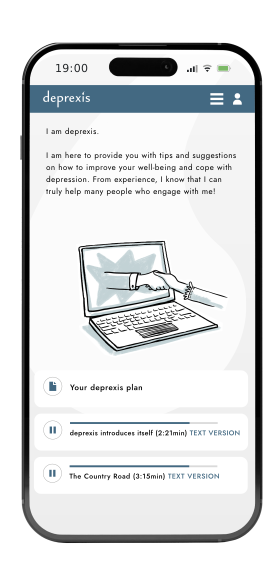
Exercises
Worksheets and audio guides support you in bringing more activity and structure back into your daily life.
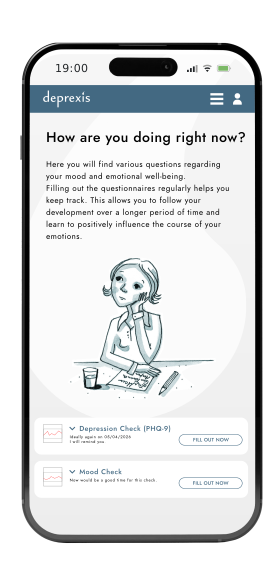
Progress
You can regularly log your activities and symptoms using questionnaires.
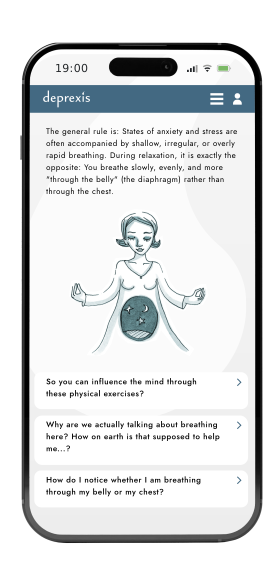
Dialogues
deprexis adapts individually to your answers and needs.
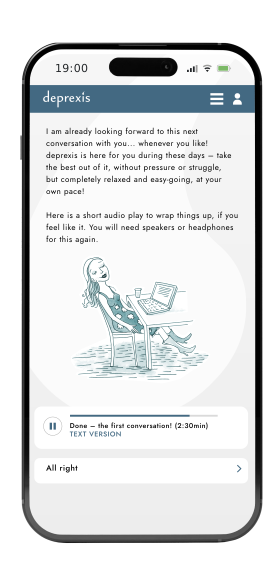
Reminders
Optional email and SMS reminders motivate you to stay on track.
As seen in












deprexis success stories

I was immediately impressed by deprexis. The program adapts to my personal needs and takes the time to get to know me first. The bird’s-eye view exercise was especially helpful.
63

deprexis taught me to think outside the box. Not always sticking to the same old routines – like taking a different route for a walk than usual, or calling someone the moment they cross my mind.
55

using deprexis was a sign for me that I was actually taking action. I knew it would help me, and it’s always better to do just a little something than to do nothing at all.
31

Any questions?
Here are the answers to the most frequently asked questions about deprexis:
deprexis is a therapeutic program that has been proven in practice for over 15 years. Its efficacy has been demonstrated in a total of 16 clinical trials, making deprexis one of the most thoroughly and extensively researched digital therapies worldwide.
deprexis was developed by GAIA AG. Backing the program is an experienced, interdisciplinary team of physicians, psychologists, and psychotherapists who designed the content in collaboration with affected individuals. Furthermore, deprexis has been peer-reviewed by internationally renowned experts, among others.
The program consists of up to ten interactive conversations designed like real dialogues. Step by step, these conversations support you in recognizing unhelpful thought patterns, gaining new perspectives, strengthening your social skills, and integrating healthier habits into your daily routine.
The content is accessible at any time, allowing you to work at your own pace, whenever and wherever it suits you. This makes deprexis a supportive and flexible therapy that can be used on its own, to bridge waiting times, or as a supplement to traditional psychotherapy.
Scientific studies show that deprexis can noticeably reduce symptoms of depression and sustainably improve your overall well-being.
You do not have to decide on your own whether deprexis is suitable for you. You will make this assessment together with your doctor or psychotherapist. Your symptoms, current situation, and alternative treatment options will all be taken into consideration. Together, you will find a treatment plan tailored to you and your everyday life.
deprexis is listed as a Digital Health Application (DiGA) with the Federal Institute for Drugs and Medical Devices (BfArM). For you, this means that if you have a corresponding diagnosis or a suspected diagnosis, all public health insurance providers in Germany will generally cover the costs of the online therapy program.
Many private health insurance companies also cover the costs of deprexis. Before you begin using the program, please check directly with your private health insurance provider to confirm whether and to what extent reimbursement is available.
Publicly insured
Public health insurance providers cover the costs of deprexis in full if you receive a statutory prescription from your doctor or psychotherapist.
Privately insured
Private health insurance companies also frequently cover the costs. To be on the safe side, you can submit a cost estimate to your insurance provider in advance. You can download the cost estimate form here.
Self-payment
If your insurance does not cover the costs or if you wish to use deprexis without a prescription, you can also purchase it directly as a self-payer. The cost for a license with a 90-day term is 297,50 € including 19% VAT.
No, a prescription is only required if you wish to receive reimbursement from your health insurance provider. If you prefer to pay for deprexis yourself, you can do so without a prescription.
In detail, the following regulations apply:
Publicly insured:
If you have public health insurance in Germany, your health insurance provider will cover the costs in full. To arrange this, you need a statutory prescription from your general practitioner (GP), a specialist, or a psychotherapist. You can use this prescription to request an activation code from your health insurance provider and use it to log in to deprexis.
Privately insured:
If you have private health insurance, you also need a prescription to be reimbursed for the costs. It is best to submit a cost estimate to your health insurance provider in advance. Once the cost coverage is approved, you can contact diga-team@gaia-group.com to request deprexis. Afterward, you send the invoice along with your prescription to your private health insurance provider for reimbursement.
Self-payers:
You can also purchase deprexis as a self-payer. Simply send us an inquiry by email to diga-team@gaia-group.com. You will then receive the activation code for deprexis and an invoice. The cost for a 90-day license is 297,50 € including 19% VAT.
Note: deprexis is an approved medical application for the treatment of depressive symptoms. Before use, please inform yourself about the field of application and possible restrictions to ensure that deprexis is suitable for you.
Confirmation of diagnosis:
If you have an existing diagnosis from a qualified professional, you can also contact your health insurance provider directly to request an activation code. You can download the diagnosis confirmation form here.
You can use deprexis either on its own or to complement other forms of therapy. However, please note that deprexis is not intended to replace treatment by doctors or therapists, nor does it provide a basis for diagnostic or therapeutic decisions. Any changes to your current medication or treatment should always be made only after consulting your doctor or psychotherapist.
First of all: There is no perfect way to use deprexis. Try to integrate the therapy program as naturally as possible into your daily routine, and make sure that using it always feels right for you. Many users have found it helpful to schedule small, regular windows of time to work through the content in peace.
The following tips may be helpful:
- A designated, quiet place: Establishing a routine makes it easier to use deprexis. For example, every Wednesday and Friday evening on the couch with a cup of tea.
- Regular sessions: We recommend spending at least half an hour in the program 1–2 times a week.
- Link deprexis with existing habits: For instance, right after breakfast or in the evening before brushing your teeth. Building on existing routines makes it much easier to stay on track.
- Openness to the exercises: Try to engage with the exercises and content with an open mind and without any pressure to perform.
- A "therapy journal": Write down the insights from deprexis that are particularly important to you in a dedicated notebook.
- Use reminders mindfully: Calendar entries or reminders can serve as a gentle invitation to yourself to do something good for your well-being.
- Allow yourself to take breaks: It is completely fine to pause conversations and resume them at a later time.
- You don't have to understand everything immediately: Some content takes time to sink in. You don't need to feel an immediate effect with every single exercise.
- Seek support: If any content feels distressing or raises questions, please feel free to talk about it with a professional or a trusted person.
deprexis is a comprehensive, interactive therapy program that offers a wide variety of exercises and content for individuals affected by depression. Here is an overview for you:
Behavioral activation
- Explanation of the connection between fulfilling, reinforcing activities and depression.
- Introduction to the concept of basic psychological needs (e.g., competence, autonomy, social connectedness).
Cognitive restructuring
- Explanation of how to manage automatic thoughts and cognitive distortions that fuel depression (e.g., catastrophizing, emotional reasoning).
Relaxation, physical activity, and lifestyle changes
- Introduction to various relaxation techniques for managing stress (e.g., breathing exercises, meditative visualization, progressive muscle relaxation).
- Importance of lifestyle changes (e.g., healthy diet, physical activity) for mental well-being.
Acceptance and mindfulness
- Explanation of the difficulties of trying to control or suppress unwanted thoughts and feelings.
- Introduction to ways of accepting such thoughts and feelings and learning how to cope with them.
Problem-solving
- Explanation of how to approach problems in a structured way as well as develop and implement potential solutions.
Childhood experiences
- A behaviorally oriented introduction to the connection between early learning experiences and the subsequent onset of depression.
- Guidance on how to process and handle problematic childhood experiences.
Interpersonal skills
- A behaviorally oriented explanation of the connection between one's own social behavior and depression.
- Insights into how to communicate positively with others and the impact this can have on your mood.
Positive psychology
- A behaviorally oriented explanation of the core elements of positive psychology (e.g., resource activation).
- Focus on personal strengths and talents.
Dreamwork (optional)
- A behaviorally oriented introduction to using dreams as an approach to problem-solving in everyday life.
Summary of key principles and techniques
- Summary of the most important principles and techniques from the previous sections.