Deliver Evidence-Based Adjunctive Relief for Depressive Symptoms — deprexis.

Evidence-Based. Accessible Anywhere.

  • CBT-Based Interactive DialoguesDelivers structured Cognitive Behavioral Therapy (CBT) principles in an adjunctive strategy, interactive, personalized virtual format, aligned with clinical practice guidelines.
  • Extensively StudiedClinical benefits supported by 11 randomized controlled trials (RCTs) involving over 2,800 participants
  • Broad ApplicabilityDesigned to support individuals across mild to severe depressive symptoms.
  • Suitable for Diverse Age GroupsEvaluated for adults across all age groups, including older adults (18+ and 65+).
  • Seamless Digital AccessAn easy-to-integrate adjunctive tool designed to complement standard clinical care without extra administrative burden.
ICD-10:

  • F32.0 / F32.1 / F32.2 depressive episode
  • F33.0 / F33.1 / F33.2 recurrent depressive disorder

ICD-11:

  • 6A70 Single episode depressive disorder
  • 6A71 Recurrent depressive disorder

Contraindications

  • F20 Schizophrenia
  • R45.8 Other symptoms involving mood (e.g., acute suicidality)
  • F23 Acute and transient psychotic disorders
  • F31 Bipolar affective disorders
  • F25 Schizoaffective disorders

deprexis: An Interactive, Adjunctive CBT Approach in a Conversational Style

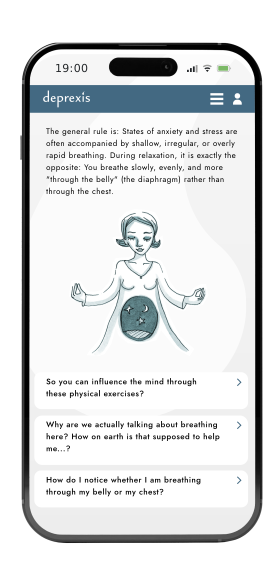
Through structured virtual dialogues, deprexis guides patients through core evidence-based CBT modules — including behavioral activation, cognitive restructuring, problem-solving, rumination management, and self-esteem enhancement.

The software dynamically adapts to patient inputs to deliver an individualized experience. In doing so, deprexis reinforces therapeutic concepts, fosters constructive cognitive patterns, and supports behavioral change in everyday life.

Exercises

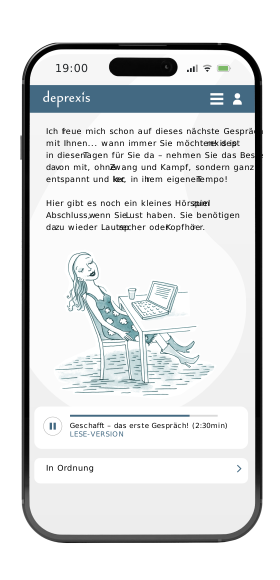
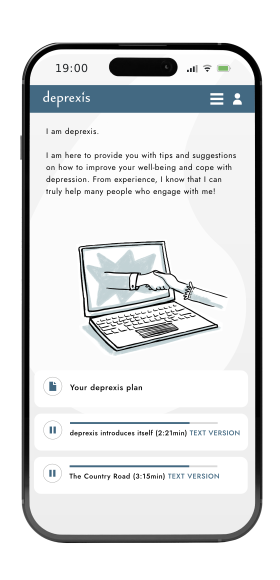
Worksheets and audio tracks support you in bringing more activity and structure back into your daily routine.

Progress

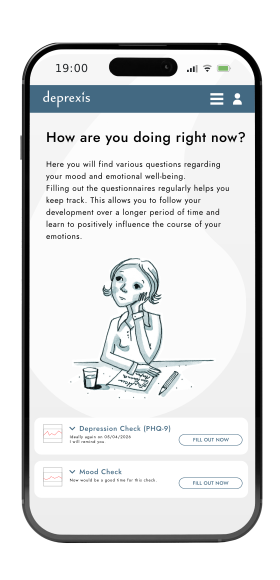
You can regularly log your activities and symptoms using questionnaires.


Dialogues

deprexis customizes itself individually to your answers and needs.


Screenshot mit Einblick in deprexis

Reminders

Optional email and SMS reminders motivate you to stay on track.


The Benefits of deprexis

With deprexis, patients receive evidence-based digital support right from the start. Designed as an adjunctive tool, the program seamlessly complements routine medical care or ongoing psychotherapy.

deprexis specifically addresses symptom-oriented CBT content (e.g., behavioral activation, cognitive techniques, relapse prevention), so patients can immediately engage with an evidence-based tool that provides continuous between-session care and helps enhance overall outcomes alongside their treatment plan.

16 Studies,
15 Years in Clinical Practice,
Proven Effectiveness

  • Scientific evidence:
    Significant reduction of symptoms proven in 16 RCTs and meta-analyses.
  • Maximum flexibility:
    Effective across all levels of severity – as a standalone intervention or to enhance the success of ongoing treatment.

Experiences from Healthcare Providers

Mann mit Bart und Brille lächelt in die Kamera

"We at DigaDocs consider deprexis to be a truly excellent DiGA that is highly versatile. It quickly gives the impression of actually engaging in a therapeutic conversation. The topics addressed provide great preparatory work for subsequent psychotherapy, or they can reinforce and deepen the content of your ongoing psychotherapy."

Dr. med. Lars Lomberg

Any questions?

Here you can find frequently asked questions about deprexis and their answers.

deprexis has been evaluated in rigorous clinical trials conducted in collaboration with leading academic institutions and clinical centers worldwide.

In the United States, research was conducted in partnership with the University of Texas at Austin (1).

International and European research partners include:

  • University of Lübeck / UKSH
  • University Medical Center Hamburg-Eppendorf (UKE)
  • Charité – Universitätsmedizin Berlin
  • University of Bern
  • Bielefeld University
  • University of Trier
  • University of Tübingen

References:

  1. (1) Beevers CG, Pearson R, Hoffman JS, et al. Effectiveness of an internet intervention (Deprexis) for depression in a united states adult sample: A parallel-group pragmatic randomized controlled trial. J Consult Clin Psychol. 2017;85(4):367-380.
  2. (2) Meyer B, Bierbrodt J, Schröder J, et al. Effects of an Internet Intervention (Deprexis) on Severe Depression Symptoms: Randomized Controlled Trial. Internet Interventions. 2015;2(1):48–59.
  3. (3) Berger T, Krieger T, Sude K, et al. Evaluating an e-mental health program ("deprexis") as adjunctive treatment tool in psychotherapy for depression: Results of a pragmatic randomized controlled trial. J Affect Disord. 2018;227:455–462.

A comprehensive list of clinical research projects, peer-reviewed publications, and study results can be found on the GAIA website in the Research section. Key clinical trials, including the large-scale EVIDENT study, and details on academic research partnerships are highlighted there and updated regularly.

In scientific and medical literature, deprexis is widely recognized as one of the most thoroughly evaluated digital Cognitive Behavioral Therapy (CBT) programs available.

Recent reviews highlight deprexis as an application backed by one of the most extensive bodies of clinical evidence in the digital health space. Meta-analyses consistently confirm its efficacy, drawing on data from 12 randomized controlled trials (RCTs) involving nearly 3,000 patients (n=2,901).

Furthermore, independent medical evaluations confirm the program's strong evidence base, noting that its adaptive dialogue structure and therapeutic functions are exceptionally suited for helping individuals manage depressive symptoms effectively.

Yes. deprexis is specifically designed as an adjunctive digital program to be used alongside your ongoing care, such as traditional psychotherapy or psychiatric treatment. It is not intended as a standalone therapy or replacement for professional treatment.

When used as an adjunctive tool, deprexis can significantly enhance overall care outcomes. Clinical research shows that individuals who used deprexis alongside their standard therapy experienced more than double the improvement in their depressive symptoms compared to those receiving traditional psychotherapy alone.

Reference:

(1) Berger T, Krieger T, Sude K, Meyer B, Maercker A. Evaluating an e-mental health program ("deprexis") as adjunctive treatment tool in psychotherapy for depression: Results of a pragmatic randomized controlled trial. J Affect Disord. 2018;227:455–462.

For healthcare providers, it is important to know that deprexis is not a static, one-size-fits-all program. It utilizes an advanced, dialogue-based system that dynamically adapts its content based on each user's specific symptoms, goals, and ongoing progress.

Through tailored choice pathways and continuous feedback, users can set their own focus areas and progress at their own pace. This responsive design ensures that the program delivers highly relevant, practical support for individuals as an adjunctive resource alongside your clinical care.

For healthcare providers, pacing and user engagement are key considerations. deprexis is intentionally designed to foster self-efficacy while preventing burnout. Users explore CBT-based content at their own comfortable pace, practicing real-world strategies and receiving structured, actionable feedback that makes their progress tangible.

To maintain a balanced and sustainable routine, the program generally encourages users to engage once or twice a week for about 30 to 60 minutes. Because the dynamic dialogue adapts to user inputs, individuals can pause, resume, or revisit modules whenever they need to, ensuring the experience remains supportive rather than overwhelming.